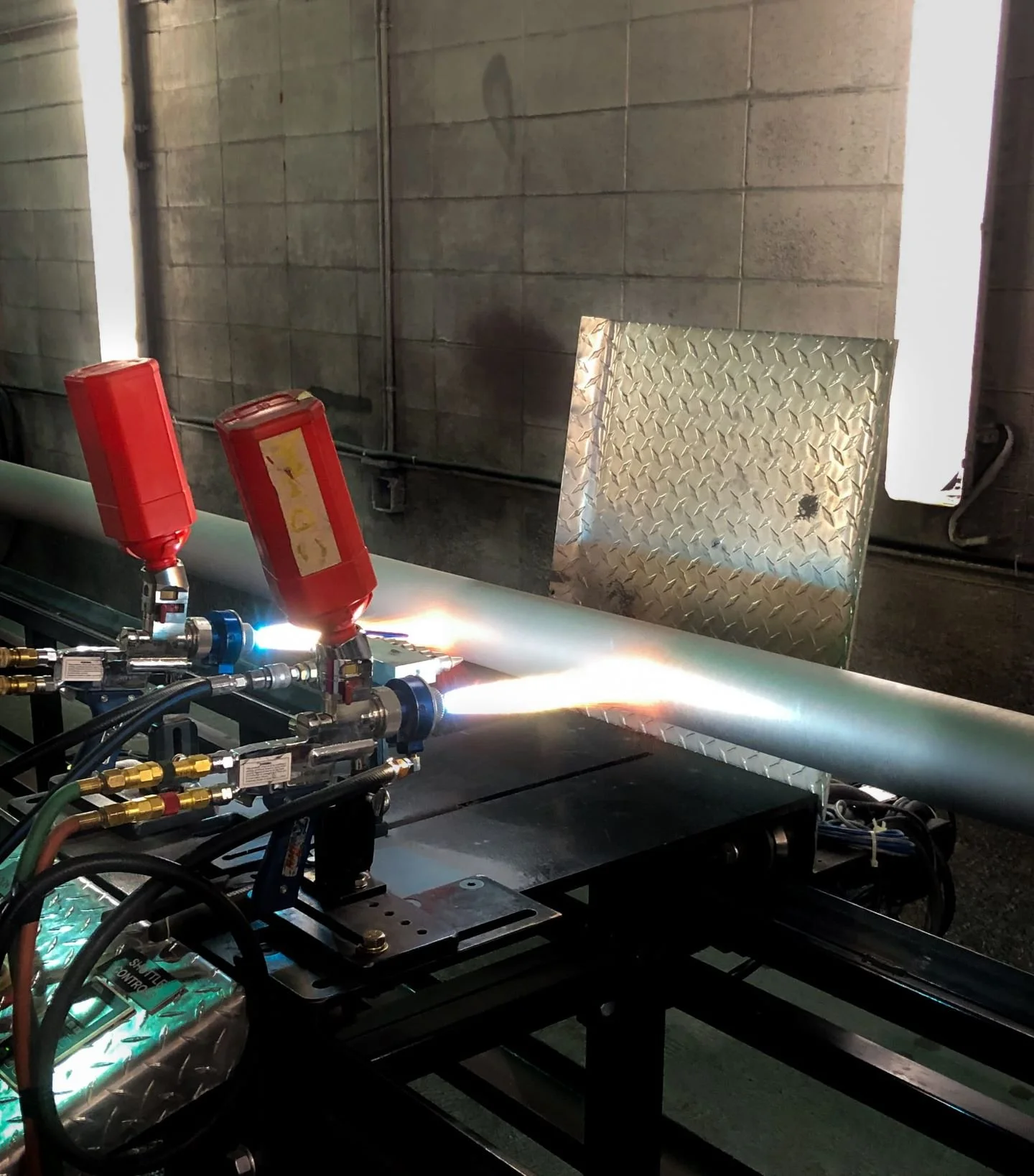
Combustion Powder Spray Coating
Combustion powder spray coating services deliver corrosion resistance, wear protection, and durable metallic coatings for industrial and marine applications. Based in Alberta and serving clients worldwide, we have been a trusted applicator for industry leaders for over 30 years. Contact us to discuss your project and request a quote.

Combustion Powder Spray Overview
What is Combustion Powder Spray and its benefits?
Combustion Powder Spray is a thermal spray metalizing process in which a fuel-oxygen flame melts a consumable feedstock — including specialty alloys such as Hastelloy and Monel, metallic powders, and ceramics — which is propelled onto the substrate surface and instantly solidifies. The resulting coating provides corrosion protection, wear resistance, thermal and oxidation resistance, and electrical conductivity across a wide range of service environments. The process's broad material compatibility makes it particularly valuable where standard zinc or aluminum wire feedstocks cannot meet specification requirements.
How does Combustion Powder Spray differ from Spray Arc Coating?
While combustion powder spray and spray arc share a similar thermal spray foundation, they differ across three key parameters where combustion spray has a wider range of coating materials (Hastelloy, Monel, Metallic & ceramics) than Spray Arc (aluminum, zinc, or an 85/15 zinc/aluminum alloy wire), but is slower in deposition rates (making it suitable for smaller parts, not large scale production), and lower bond strength (weaker environmental protection). Generally, Combustion spray coating is best for small- to medium-scale repairs, and Spray Arc offers higher corrosion protection and greater production capacity.
Where is Combustion Powder Spray commonly used?
Combustion powder spray is most commonly specified for repair, restoration, and maintenance on pump shafts and journals, seals, motors, impellers, diffusers, and housings—where its flexibility and lower setup requirements make it more practical than HVOF for small- to medium-sized components. Ceramic feedstocks are used in thermal barrier coatings and electrically insulating surfaces, where metallic spray processes cannot meet specification requirements. In oil and gas and rotating equipment maintenance, combustion powder spray is routinely used to restore worn components to original dimensions.
Why choose Custom Coatings International?
In industries where coating failures can drive excessive repair and maintenance costs, choosing an experienced, proven applicator is critical. With over 30 years of experience applying protective coatings and references including Baker Hughes, CCI has earned a reputation for delivering high-quality coating finishes on time and to specification. Contact us to request a quote or discuss your application.

Metallic & Ceramics
Combustion spraying offers a cost effective alternative for applying metallic and ceramic coatings in a less demanding environment. The process relies on the chemical reaction between oxygen and a fuel of combustion to produce a heat source. The heat source creates a gas stream with a temperature in excess of 3,000°C with correctly balanced conditions between oxygen and acetylene. A consumable, usually a powder or wire, is heated and propelled onto a substrate to form a surface coating.
- Pump shafts/journals
- Seal areas
- Impellers
- Diffusers
- Housings
- Structures

Hastelloy
A nickel-molybdenum-chromium superalloy with an addition of tungsten designed to have excellent corrosion resistance in a wide range of severe environments. The high nickel and molybdenum contents make the nickel steel alloy especially resistant to pitting and crevice corrosion in reducing environments while chromium conveys resistance to oxidizing media. The low carbon content minimizes carbide precipitation during welding to maintain corrosion resistance in as-welded structures. This nickel alloy is resistant to the formation of grain boundary precipitates in the weld heat-affected zone, thus making it suitable for most chemical process application in an as welded condition.
- Excellent corrosion resistance in reducing environments
- Exceptional resistance to strong solutions of oxidizing salts, such as ferric and cupric chlorides
- High nickel and molybdenum contents providing good corrosion resistance in reducing environments
- One of the few materials to withstand corrosive effects of wet chlorine gas, hypochlorite and chlorine dioxide
Monel
Monel is a nickel-copper alloy (about 67% Ni – 23% Cu) which exhibits excellent corrosion resistance. Generally, its corrosion resistance is very good in reducing environments, but poor in oxidizing conditions. It is not useful in oxidizing acids, such as nitric acid and nitrous. Nevertheless, it is resistant to most alkalis, salts, waters, food products, organic substances and atmospheric conditions at normal and elevated temperatures. This nickel alloy is attacked in sulfur-bearing gases above approximately 700° F and molten sulfur attacks the alloy at temperatures over approximately 500° F. Monel 400 offers about the same corrosion resistance as nickel but with higher maximum working pressures and temperatures and at a lower cost due to its superior ability to be machined.
- Resistant to sea water and steam at high temperatures, salt & caustic solutions
- Good weld ability at high strength
- Low corrosion rate in rapidly flowing brackish or seawater
- Excellent resistance to stress-corrosion cracking in most freshwater
- Resistant to a variety of corrosive conditions led to its wide use in marine applications & other non-oxidizing chloride solutions
- Particularly resistant to hydrochloric and hydrofluoric acids when de-aerated
- Excellent resistance to neutral and alkaline salt
- Resistance to chloride induced stress corrosion cracking
- Good mechanical properties from sub-zero temperatures up to 1020° F
- High resistance to alkalis
- Virtually immune to chloride ion stress corrosion cracking in typical environments
Let’s Discuss Your Project
Need help finding the right solution? Contact us below or fill out the contact form, and the appropriate customer service specialist will contact you.