
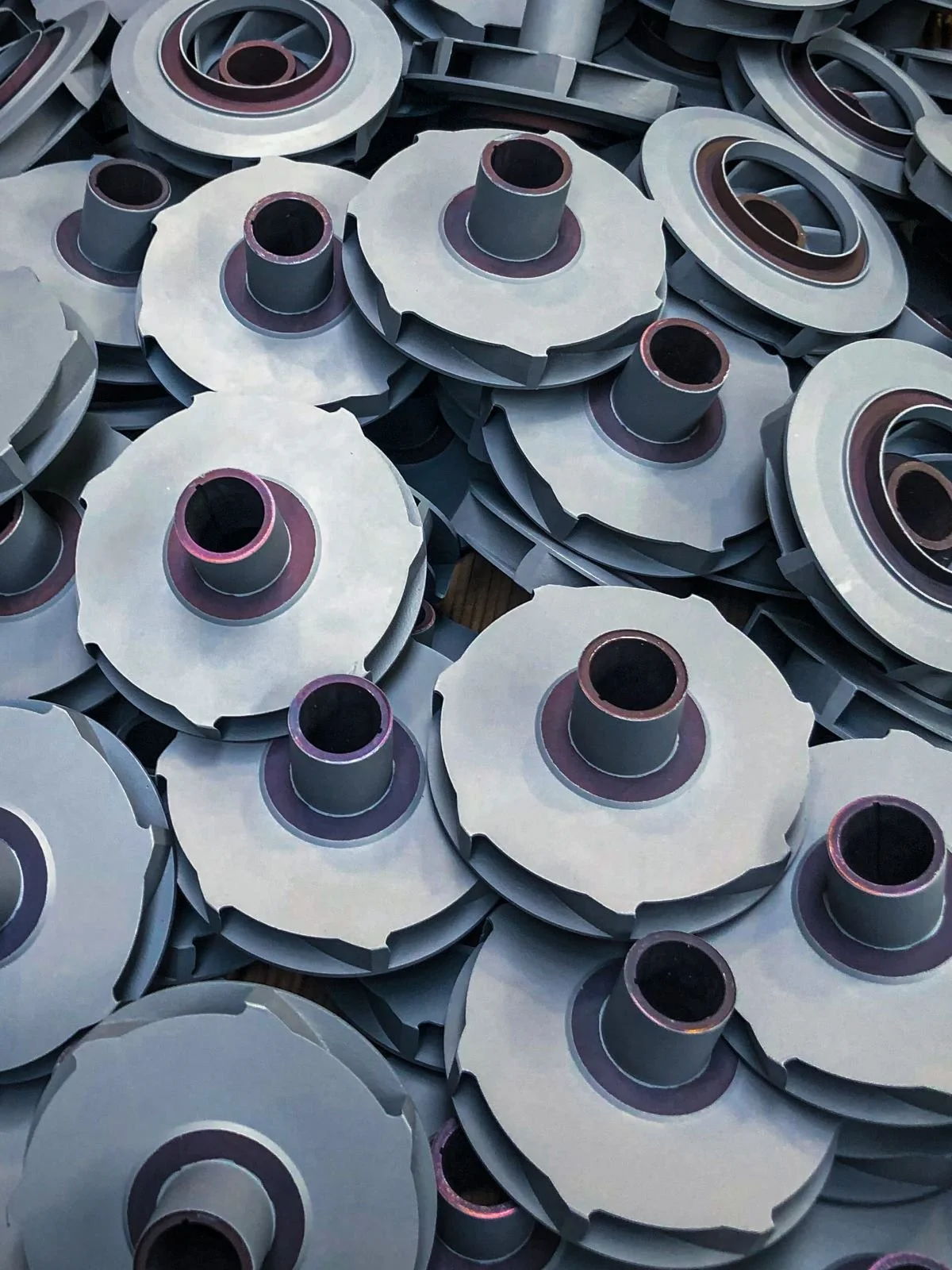
Molybdenum Disulfide “Moly” Coating Services
Moly Coating is a high performance dry lubricant/ anti-galling coating, with exceptional environmental tolerance. Contact us to discuss your project and request a quote.

Moly Coating Overview
What is Moly (MoS₂) Coating?
Moly Coating, also known as Molybdenum disulfide (MoS₂) coating, is a dry-film solid lubricant that provides low friction, robustness, and chemical stability. CCI applies MoS₂ coatings accurately to manufacturers' specifications. See our technical data sheet for coating properties and film thickness ranges.
What makes Moly Coating effective?
Moly Coating acts as a sacrificial layer, transferring a thin lubricating film between mating surfaces to prevent galling, fretting, and seizing. Moly coating replaces oils and greases as the superior lubricant option for applications requiring high load-carrying capacity, reduced wear, vacuum stability, and low coefficients of friction.
What substrates can Moly Coating be applied to?
Like PTFE Coating, MoS₂ lubricant can be applied to most metal substrates, including stainless steel, carbon steel, brass, and anodized aluminum. However, substrates such as tin, lead, magnesium, and copper aren’t ideal candidates for Moly coating due to the high curing temperature.
Where is Moly Coating used?
Moly Coating is commonly used for downhole tools, valve stems, fasteners, and aerospace components that operate under extreme loads or in environments where liquid lubricants are impractical.
Why choose Custom Coatings International?
In industries where coating failures can drive excessive repair and maintenance costs, choosing an experienced, proven applicator is critical. With over 30 years of experience applying protective coatings and references including Baker Hughes, CCI has earned a reputation for delivering high-quality coating finishes on time and to specification. Contact us to request a quote or discuss your application.
Properties of Moly Coatings
Molybdenum disulfide is chemically stable and relatively unreactive, remaining unaffected by dilute acids and oxygen. It also offers impressive thermal resistance:
- In non-oxidizing environments: → stable up to 1,100°C (2,012°F)
- In air/oxidizing environments: → stable up to 350–400°C (662–752°F)
Key performance characteristics include:
- Low coefficient of friction (0.03–0.06 in many applications)
- High load-bearing capacity (exceeding 250,000 psi)
- Excellent wear resistance
- Effective lubrication without oils or greases
- Performance in vacuum and extreme environments
Why Choose CCI
Choosing a Molybdenum disulfide coating provides several advantages over conventional lubricants and other coating systems:
- Dry film lubrication – Functions where oils/greases are impractical.
- Reduced wear – Extends service life of critical components.
- High load performance – Handles extreme pressure applications.
- Temperature stability – Performs in both cryogenic and high-heat conditions.
- Clean operation – Does not attract dust, dirt, or contaminants.
- Corrosion protection – Adds a protective barrier against moisture and oxidation.
Comparison to Other Coatings
While coatings such as PTFE (Teflon) or graphite are also used as lubricants, Moly coatings excel in high-load, high-pressure environments where others may fail. MoS₂ coatings provide superior load-bearing strength, vacuum stability, and resistance to extreme pressures, making them the preferred solution for mission-critical applications in aerospace, defense, and heavy industry. In fact it is common to use a combination of Teflon coating and Moly coating on pieces, where the body is coated in Teflon, but the threads are masked and later coated with a Moly Coating. This provides the best solution between the two coating systems.
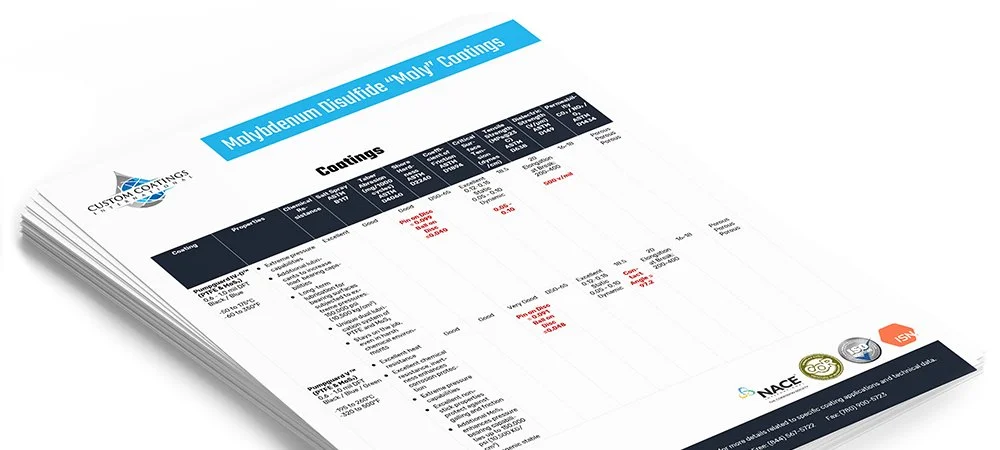
MOLY COATING TECHNICAL DETAILS
For specifics on how molybdenum disulfide coatings can help you, download the PDF below.
Lets Discuss Your Project
Need help finding the right solution? Contact us below or fill out the contact form and we will have the appropriate customer service specialist contact you.


Molybdenum Disulfide “Moly” Coating FAQs
-
Moly coatings are primarily used in aerospace, automotive, defense, and industrial applications where low friction, high load-bearing capacity, and performance in extreme conditions are critical.
-
Moly coat is used primarily on areas to prevent galling/anti-seizing. This includes threads on parts, screws, bolts, washers, and other fastener components.
-
Moly Coating is very similar to Teflon coatings in terms of properties, corrosion, and chemical resistance. However, Moly Coating is a more specialized dry lubricant coating than Teflon coating, offering better anti-galling / anti-seizing properties on parts and components.
-
Moly Coatings is one of the best options for anti-galling/ anti-seizing on parts and components.