

TEFLON/ PTFE COATING SERVICES
Custom Coatings International is an industry leader in polymer “Teflon” coating applications, protecting equipment from corrosion and harsh environments across Alberta and internationally for over 30 years. Contact us to discuss your project and request a quote.
PTFE COATING OVERVIEW
What is PTFE Coating and its Benefits?
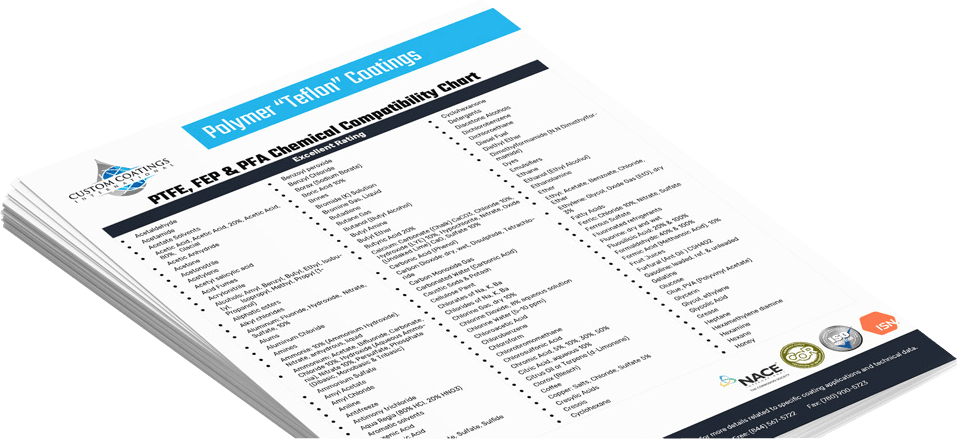
PTFE (polytetrafluoroethylene) coating, also known as Teflon®, is a high-performance protective coating characterized by its broad chemical inertness (resistant to most acids, bases, and solvents), exceptionally low coefficients of friction (ideal for product release, reduced wear, and elimination of liquid lubricants), and a diverse operating temperature range (ranging from -270 and 260°C). For detailed chemical compatibility data across PTFE, FEP, and PFA systems, view our compatibility PDF.
What Substrates Can PTFE Coating Be Applied To?
Teflon Coating can be applied to most common metal substrates, including stainless steel, carbon steel, brass, and anodized aluminum. However, substrates such as Tin, Lead, Magnesium, and Copper aren’t ideal candidates for PTFE because the application requires a high curing temperature.
Which Types of Teflon Coating Does Custom Coatings International Apply?
CCI is a trusted, approved applicator for PTFE, FEP, PFA, and ETFE coatings from PPG's Xylan Coating Series and DuPont's Teflon product line, meeting manufacturers' coating specifications accurately and consistently. In addition, CCI offers Pump Guard Coating, a proprietary, patented Teflon coating formula developed in-house for pump components and fluid-handling equipment that require superior nonstick and chemical resistance. View our full coating options PDF for system specifications and application data.


BENEFITS OF POLYMER/ PTFE COATINGS
All types of polymer Teflon coatings provide a wide range of performance benefits, including:
- Non-wetting & anti-fouling surfaces
- Noise reduction
- Unique electrical properties (high dielectric strength)
- Abrasion resistance
- FDA-compliant options (for select coatings)
- Non-stick properties
- Low coefficient of friction
- Heat resistance (up to 260°C / 500°F depending on the coating type)
- Cryogenic stability
- Chemical & corrosion resistance
TYPES OF TEFLON COATINGS
260°C / 500°F
Maximum operating temperature
PTFE
Polytetrafluoroethylene
Lowest coefficient of friction among fluoropolymers
Excellent chemical resistance
Good abrasion resistance
204°C / 400°F
Maximum operating temperature
FEP
Fluorinated Ethylene Propylene Copolymer
Outstanding non-stick properties
Ability to coat complex geometries uniformly
High chemical resistance and dielectric strength
260°C / 500°F
Maximum operating temperature
PFA
Perfluoroalkoxy
Tougher than PTFE and FEP coatings
Excellent chemical resistance
High dielectric strength
149°C / 300°F
Maximum operating temperature
ETFE
Ethylene Tetrafluoroethylene Copolymer
Exceptional toughness and durability
Excellent chemical resistance
Highly protective in demanding environments

WHAT IS PTFE APPLICATION & PERFORMANCE?
PTFE Coatings can be applied using advanced methods such as spraying, dipping, or electrostatic coating, followed by a precision baking process that bonds the coating securely to the substrate. Proper surface preparation—through cleaning, grit blasting, and priming—is essential to ensure maximum adhesion and long-term durability.
One of the most valuable advantages of PTFE Coatings is their ability to maintain performance in extreme environments. These coatings remain stable from cryogenic conditions to continuous high-heat exposure up to 260°C (500°F), making them ideal for industries that demand reliable performance in harsh conditions, including oil and gas, food manufacturing, and chemical processing.
Compared with alternatives such as epoxy or ceramic coatings, PTFE Coatings offer a unique balance of non-stick functionality, chemical resistance, and low friction that competing technologies cannot match. This combination helps prevent material buildup, reduces energy loss from friction, and ensures equipment runs efficiently with minimal downtime.
PTFE COATING INDUSTRY APPLICATIONS

Industrial Equipment
Pumps, valves, bearings, fasteners, diffusers, impellers, inducers, sleeves, nuts, bolts, studs, and more.
Food Processing
Bakeware, conveyor systems, cutting tools.

Automotive & Aerospace
Engine parts, seals, sliding mechanisms.

Medical & Pharmaceutical
Surgical instruments, catheters, lab equipment.

Consumer Goods
Cookware, electronics, household appliances.
POLYMER TEFLON COATING TECHNICAL DETAILS
For information on different coatings, chemical compatibility and more, download the PDFs below.
Credentials
- ISO 9001-certified, ISN member contractor, and COR-certified
- NACE Level 1 & 2 Certified Coating Inspectors on staff, with NACE Level 3 Certified Coating Inspectors available upon request
Quality Assurance & Control
- Surface preparation to SSPC/NACE standards, with profile measured and recorded per specification
- Climate-controlled blast and coating bays for proper application and cure
- QC testing, including ambient condition monitoring and DFT readings provided in every project
- X-cut adhesion, compressed air (blotter), dust, and soluble salt testing, and holiday testing available upon request
- Inspection and Test Plans (ITPs) and QC documentation available upon request

WHY CHOOSE CUSTOM COATINGS INTERNATIONAL?
CCI has invested significant resources in building and strengthening our quality assurance and control department, training our team to ensure every project meets specifications.
REQUEST A QUOTE
To initiate the quoting process, please provide the following information (if available):
• Drawings or isometrics
• Coating specifications
• Operating environment details (temperature range and chemical exposure)
• Project timeline or required completion date
We look forward to working with you on finding the right protective coating for your project. If you have any questions, please contact us using the links below.

Info@ccintl.ca for general inquiries

sales.support@ccintl.ca for quote requests
PTFE COATING FAQS
-
There is no effective way to spot-repair Teflon (PTFE) coatings. When a Teflon coating is damaged or worn, the most reliable solution is to fully remove the existing coating and reapply a new one. This process typically involves abrasive blasting to prepare the surface, followed by recoating and thermosetting in an industrial oven to ensure proper adhesion and performance.
Depending on the part and application, stripping and recoating Teflon can be a more cost-effective solution than replacing the component entirely.
-
Yes, CCI applies both Xylan and DuPont coatings. CCI specially stocks several types of Xylan coatings in shop, allowing for quick turn around times of parts and components.
-
Custom coatings internation has worked with a variety of industries internationally but has extensive experience in serving the oil and gas industry here in Alberta and expanding out to Wyoming, Oklahoma, California, and markets outside of North America.